The UK has a problem with competitiveness. The seeds are sown in primary school, they sprout throughout the teenage years and engulf people in adulthood. Everywhere you look people are striving to be cleverer, prettier or richer. They’re flexing their shiny cars, their cool holidays and their children’s exam results. Not me obviously, though did I mention that I’m writing this lying on a lounger on a beach in Greece?
If you try and ask the internet if the UK is a competitive country it starts showing off about how the UK ranks highly amongst other countries in its business competitiveness, simply proving my theory.
You can observe competitiveness in letters to newspapers where the authors declare that they are professors or doctors. You hear it on the radio when presenters and guests demonstrate their knowledge of classics or other obscure topics in a game of intellectual one-upmanship. You see it in the curated bookshelves behind people on Zoom calls which reveal how well-read (and (ahem) ergo, clever) they are. And obviously and overwhelmingly social media is built on the bricks of boastfulness and held together with the cement of smugfulness (that’s not a real word by the way, but I’m planning on trademarking it and adding ‘trademark expert’ to my work email signature).
So, what’s the problem?
The problem is represented by the people in this cartoon: someone is always trying to get ahead, and by getting ahead, they win and others lose.

This win-lose mentality ensures that many people (even the majority?) are made to feel inadequate. They’re just not as pretty/rich/successful (delete as necessary) as their friends. I say ‘they’ because of course this doesn’t affect me, does it? Does it?
There are two big influences on this type of win-lose hyper-competitiveness. Firstly there is the ubiquitous academic elitism present in the UK system. Secondly there is our obsession with money and status. Both of these are of course exacerbated by social media and the chance to seamlessly amplify any boast-worthy topic.
Our competitive education system
The UK’s education system forces children from a young age to compete with each other for gold stars, team points or ‘headteacher’s awards’. We make school ‘houses’ that are required to be rivalrous. We force stressful testing upon small children and expose their weaknesses by divulging the results in public. We oblige schools to compete with each other for pupils which leads to money being wasted on advertising and endless boastful social media promotion. We use OFSTED to judge and compare. We make tertiary educational establishments spend millions on advertising to attract students both nationally and internationally.
Our country’s obsession with academic ‘success’ turns non-academic children into ‘failures’ which causes harmful disengagement with the education system it ensures that issues such as truancy become ubiquitous. Recent English figures show that nearly 20% of school children are absent from school for at least 10% of the time. In the year 2018-2019 only 11% were persistently absent. Clearly conditions in schools are unappealing to a large number of children. This matters not only in terms of academic results but also for future earnings – with an estimated £750 lost per day of secondary school absence over a lifetime! Of course, this demonstrates correlation and not necessarily causation but even so – all that unearned money! See here for some ideas on how to radically overhaul the education system to reduce inequality and competitiveness from the start.
Money and status
The media loves to describe people by how much money they have (to be honest I say people, but it’s mostly men – lucky chaps!)– e.g. ‘the world’s first trillionaire etc. There’s a Rich List published in the Sunday Times and just generally lots of interest in how much stuff costs. And pity those (un)lucky enough to go to Eton or suchlike where keeping up with the (Smyth-)Jones’s means comparing yourself to royalty. And pity our poor royals still more when the papers announce that the Saudi royal family owns 16 times as much money as they do. Damn, if only there was oil under Windsor Great Park. This is the problem with comparison; it makes nearly everyone feel poorer, smaller and ready to start digging for hydrocarbons. It’s obvious that many people in the UK are currently dissatisfied with their lives which is being born out both politically and on the streets. Part of this dissatisfaction must be the result of a sense of being left behind or feeling unsuccessful in comparison to others. Governments must do all they can to make sure everyone is able to live a good life (read the section on education here! It’s key to everything).
How can we reduce this competitiveness?
As with all things we need to start by noticing the issue. Our society is littered with more ways in which people are made to feel inferior to others than fast food wrappers. We need to collectively decide that we want everyone to feel like an equally valued member of society – whatever your GCSE’s grades or however many bedrooms you own.
Here are some things that could be easily changed: car number plates currently reveal the age of the vehicle and invite easy comparison. Perhaps your new car makes you feel special or perhaps your old car makes you feel a bit rubbish (full disclosure: my car was manufactured in 2004 #toyotaslastforever). This could be changed quicker than you can say automatic number-plate recognition technology. Many trains still have first class carriages – so everyone else is by extension second class? Why not call them ‘deluxe’ carriages if they have to exist. Titles such as Dr, Wing Commander, Major etc. suggest that some people’s jobs are superior to others. Radical idea – let’s call people just by their names, which would also overcome the issue of women needing to declare their marital status at every turn.
Let’s try to create a society which is represented by this diagram where everyone is working together.
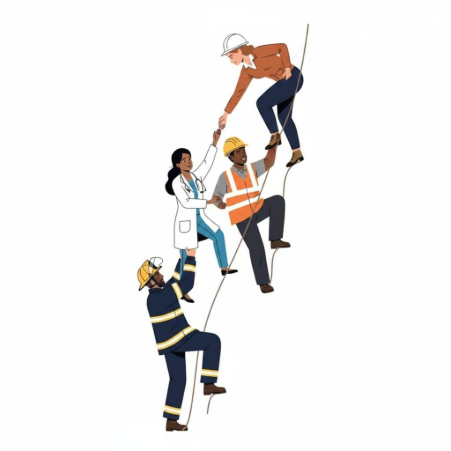
Dogtanian knew that the best way is one for all and all for one!*
*Yes I know that the original story concerned Count d’Artagnan – but who (hoo,hoo,hoo) didn’t enjoy the Dogtanian reference?
Leave a Reply